50th Anniversary Celebration

The 50th Anniversary of Bushland Conservation was celebrated immediately after the 2025 AGM. This anniversary is indeed a major milestone for the company. It is a testament to the founders vision and the ongoing efforts of members to grow and maintain its properties for conservation.
The celebration was attended by 35 members and family including four generations of Smyths. The program included a number of speakers on topics covering the company’s conservation activities of the last 50 years and the impressive flora and fauna on its properties. This highlighted the impressive depth and breadth of experience and knowledge within the company’s membership. There was also the opportunity for members to contribute their own memories and anecdotes, including poems for the occasion.
Some members took the opportunity to have a guided tour of the recent re-vegetation projects on the property and walk the Rockleigh Nature Trial established by Angela Wilde and Nic Nicol. Nic prepared a special bookmark to marl the annesversary.
Agenda
- Chair Opening Remarks. (David Smyth)
- 50 Years of Preserving Bushland (Peter Vincent)
- The Tothills Story (John Smyth)
- Conserving Unique Vegetation Associations (Denzel Murfet)
- The Birds of Rockleigh (Graham White)
- The Enigma Moth – A Remarkable Find (Tom Reeves for Richard Glatz)
- Talyala – Our Recent Addition (Steve White)
- Member Discussion (Max. 5 mins each)
8.1. Opportunity for members to share stories, anecdotes etc.
8.2. Please bring any photos that may be of interest
1. Opening remarks – David Smyth

Chair’s Opening Remarks
David Smyth, Shareholder 1980-86, 1993-present
I will focus on the role of three key people (others will discuss history, land, wildlife)
- John Smyth
Founder of company (with Robert (Alfie) and Ian Hannaford, and brother Michael)
Secretary/Treasurer from 1975-2013 (38 years)
Success based on 3 strengths:
Enthusiasm for conservation
Ability to attract like-minded shareholders
Walking the delicate tightrope of managing land and people
(helped by farming background)
Recognised by Medal of the Order of Australia, and Landcare Award for Bushland - Graham White
Secretary/Treasurer from 2013-2022 (9 years)
Carried on the flag
A manager at Rockleigh as well as a big picture person (revision of the Constitution)
Strong supporter of acquisition of ‘Talyala’, our fourth property
Committed birdwatcher - Peter Vincent
Secretary/Treasurer from 2022
Second generation shareholder (parents were David and Jeanine Vincent)
Business and management background
Had his arm twisted to become Secretary/Treasurer and has thrived in the role
Ideas and actions person – e.g. exclosure at Rockleigh, addition to Tothills
Along with John and Graham, a keen birdwatcher,
(this seems to be a condition for the position!) - In conclusion, on behalf of all shareholders I sincerely thank all 3 for their vision, hard work and demonstrated success in making us effective in the selection and management of bushland.
******************************************************************************************************************
3. The Tothill Range- John Smyth

My first close sighting of the Tothill Range was in about 1985 when I was
driving on an unknown road to me called Tothill Belt Road, which runs north-
south for 20 km parallel to the Range, and about 2 km west of it, North of
Marrabel and South of Burra. Being a nature lover from childhood, I was
impressed with the thick native scrub on the distant Range, so decided to
return one day very soon with bush camping gear and walk across country
from Tothill Belt Road road, there being no close-by roads across the Range, to
the highest part of the Range, Lagoon Hill of 688 metres above sea level.
On reaching the scrub I was delighted with its density and composition, being
virtually weed free and with abundant yakkas, a rarity in the Mid North. In the
evening I spread my plastic groundsheet, airbed and sleeping bag on the very
top of the steep ridge. Early next morning I was awoken by a rustling of the
plastic sheet and was thrilled to discover an echidna actually walking on my
bedding! On my sitting up, it turned tail and headed down the precipitous
slope, tumbling occasionally as it went. So I was immediately smitten with the
Tothill Range.
Over the next few years, and before Bushland Conservation bought its first
Tothills land in 1990, I became familiar with the flora, fauna and geology of the
Range, realising it as being an un-spoiled gem of the Mid North. One weekend I
walked along the whole 20 km of the rough ridge- top and across to the Burra
Creek Gorge camp ground where I had arranged for my wife Meg to pick me
up. A great walk over 2 days, and with 2 nights bush camping.
Geologically the Range is one of the several parallel north-south aligned ranges
of tilted beds of hard quartzite and tillite in the Mid North, with the
intervening valleys eroded in softer shale rocks. All this sedimentary rock was
deposited as silt over millions of years in a shallow sea, the Adelaide Geo-
syncline, in the pre Cambrian era, then as solidified rock, forced up to become
mountains by the movement of the local tectonic plates. Australia at this time
was still attached to Antarctica as part of Gondwana. The mountains were
slowly eroded to hills, with the eroded rock particles heading off to the sea
again as sand and mud in the local creeks and Rivers. All these processes have
taken huge spans of time to create the Tothill Range as we see it now.
The vegetation of the Range is composed of an over-story of eucalypt trees,
mostly peppermint box and blue-gums, with some long-leaved box, as well as
she-oaks and native cherries. The mid-story is of yakkas, golden wattles and
many interesting shrubs, with a ground cover of small perennial and annual
shrub species, grasses, orchids, daisies and lilies. The soil is mostly strongly
acidic, and the best areas are weed- free. In Spring of a good year the native
flowers are a delight.
The native fauna includes 3 kangaroo species, brushtail possums, one Dunnart
species (tiny marsupial mouse), native bats, lizards, 2 snake species, echidnas,
frogs, and many bird species. There are feral cats in low numbers, foxes, hares,
the occasional rabbit and a few red deer.
It has been a privilege to get to know in detail the wonderful Tothill Range,
including being involved with the Company that now protects under Heritage
Agreement a large area of the best of it.
After 15 years with only the KI property and a small number of shareholders,
Alf Hannaford and I became aware in 1990 that outstanding scrubland with
which they were already familiar, was for sale in the Tothill Range, 40 km north
east of Riverton. We decided that the existing Company would be the ideal
vehicle for the acquisition of this property, if the asking price of $526 per
hectare ($215 per acre) for 440 acres could be raised, so a search was on for
more shareholders. In contrast to the “cheap” KI land situated in an area
where huge tracts of scrub still existed, this land was in the largely cleared Mid
North of SA, and much more expensive. However, by word of mouth only,
(another statutory requirement for private companies) and probably aided by
the prospect of being a part ‘owners’ also of the beautiful KI land, the money
was soon promised by new (and existing) shareholders. Of special note in this
regard were Bob Brown of Adelaide, Anne and Peter Reeves of Sydney
(formerly of Adelaide), and Janet Smyth, who all strongly supported the
Company at this time of expansion. The Directors agreed to purchase the land,
so the Company and its shareholders acquired another wonderful property and
many new shareholders!
One year later an adjoining Tothills Section was bought, and this time the first
instance of allotting the seller some shares in lieu of full payment for the land
was negotiated, a strategy used several times in later purchases.
In 1991, direct seeding of local native trees and shrubs on some open weedy
areas on the edge of the Tothills land was started, using seed collected from
the property. Greening Australia provided initial assistance to demonstrate the
technique; in later years we used a seeding machine built by the Tothills
Landcare Group. Over the next 6 seasons we seeded a total of about 20
hectares with excellent results, luckily aided by a succession of favourable
years with sufficient summer rain to get the tiny seedlings through the critical
first year. Growth was initially dominated by the Acacias in the mix of species
sown. These are now senescing and the Eucalypts are becoming dominant. It
has been interesting to watch this change. These plantings later earned several
thousand dollars in carbon credits for the Company through Landcare Australia
Ltd’s innovative CarbonSMART scheme. It was our luck again that this national
scheme included plantings back dated to 1991, the very year we started!
In 1993 another Tothills section was advertised for auction. This block included
one third excellent scrub on the ridge, close to but not adjoining our other
land, and two thirds arable and grazing land, with no dividing fence between.
The Directors instructed me, as Secretary, to attend the auction and to bid to
$40,000, with the intention of eventually sub-dividing off and re-selling the
farming land, should we be the successful bidder. Remarkably, our last bid of
$40,000 was successful, the runner-up being the local Allchurch farming family
who had sold us our first Tothills land 3 years previously! With the approval of
the Directors, John negotiated to lease the farming land to the Allchurch family
after fencing off the scrub portion which we placed under Heritage Agreement.
Two years later, in 1995, again I negotiated on behalf of the Company a
complicated but very successful deal with Barry Allchurch whereby we
‘swapped’ this leased land for some of his scrubland further along the ridge,
thus linking all of our scrub sections. This deal involved the sub-division and
fencing of the land and its use according to land class. The fact that a peregrine
falcon chick was occupying a nest on a cliff on the ‘swap’ land was added
incentive for us to acquire it in exchange for our leased section.
As we were getting much more land than they were in the swap, we agreed to
allocate sufficient shares to the Allchurchs to balance the values, they being
happy to join the Company and thus retain an interest in ‘their’ scrub!
(Although technically the shareholders don’t own the land, only shares in the
Company which does, I’m sure this makes little difference to the feeling of
ownership)
A further small block of adjoining Tothills scrub was purchased in 1994 and
again a sub-division and fencing was required. We agreed to pay the survey
costs for this sub-division, a practice we continued for some later purchases.
This block was suffering significant grazing damage by the owner’s sheep,
which initially was a worry, but it was anticipated that it would recover with
grazing removed. This has proved to be the case.
1997 saw the purchase of another scrub block in the Tothill Range, 4 km north
of our other land there. To get Council consent for the required sub-division on
the land class boundary, namely the edge of the scrub, we needed to ‘plead
the case’, as the remaining arable land which we were not purchasing was
slightly less in area than the Council’s Land-use Plan officially allowed. We were
successful, Council recognising that we had a strong case and a history of
successful land management in the Range.
Our next land purchase in the Tothills occurred in 2008 after local graziers
Geoff and Elizabeth Mosey offered us first option on their approximately 325
hectares (800 acres) of good scrubland adjoining our northern block, at $375
per acre. We were unable to finance the purchase of the whole block, but with
generous support from many existing shareholders and the allocation of some
shares to the Moseys in lieu of full payment, we purchased over half (189
hectares or 466 acres). The remainder was bought in their own names by Tom
and Alison Bullock, already “Bushland” shareholders, who have put nearly all of
their section under Heritage Agreement, and have re-vegetated a previously
cleared site excluded from the Heritage Agreement. There is no fence between
the Bullocks land and ours. We sourced Natural Resources Management Board
and Heritage Fencing Scheme grants totalling $25,000 for materials and labour
for the necessary replacement of most of the boundary fencing which was in
poor condition. Again, the benefit of being a Landcare Group and having a
Heritage Agreement on the land is obvious. (A previous NHT grant of $15,500
in the year 2000, organised by shareholder Andrew Wurst, was used to replace
old Tothills fences). This purchase increased our holding at this time in the
Tothills to 661 hectares (1,635 acres). Together with the Bullocks land, a
stretch along the Range of 11 km with some of the best of the Tothills scrub is
now fully protected, including 2 plant species (Tothills Bush-pea and Bendigo
Wax-flower) of high conservation significance in SA.
In 2024 the Mosey family sold us two Sections of excellent steep scrubland on
the Eastern side of the Range, and adjoining some of our previously purchased
sections on the Western side.
Bushland Conservation Pty Ltd was an early leader in corporate nature
conservation in Australia. There are now 2 very large National organisations
doing similar work on a huge scale, namely Australian Wildlife Conservancy,
and The Australian Bush Heritage Trust (Bush Heritage Australia). Although
Bushland Conservation Pty Ltd is tiny in comparison, the shareholders are
pleased to have been able to conserve and enjoy some of SA’s remaining
natural bushland, using the corporate model to allow our shareholders to
jointly achieve what individuals may have found impossible. John’s farming
background has probably helped in his dealings with other farmers who have
sold us most of our land.
Over the years I have written several short letters to all the shareholders on
the wonders of the Tothills, with those members unable to visit the property in
mind. I included photos of the wildflowers in the Spring, but in one very dry
year I was at a loss to find anything to photograph, so decided instead to let
the Tothills ‘speak’ for themselves! I will now read to you this letter to
conclude my contribution to the 50th year celebration of the Company’s
existence.
The Tothills speaking.
“Hello friends. This is the Tothill Range speaking to you; the first time I have
ever done so! I would like to thank you all for taking an interest in me, and
protecting my major tenants, the Flora and the Fauna families. They are
suffering a bit with the dry conditions this last 2 years or so. Myself, being
made of solid rock, which the geologists call Appila Tillite, and the soil derived
from it, I don’t mind what the weather throws at me; I’ll still be around for
many more millions of years!
My major tenants the Flora family are a diverse lot. I love especially the yacca
children. They are happiest to grow among the rocks of my ridges, and look
quite charming in an ancient “primitive” way, as do the few echidnas of my
Fauna family tenants. Mind you, I had been around for millions of years before
either of my tenants arrived, so it’s me that is truly ancient. You also protect 2
other very important Flora family tenants of mine, namely the rare Tothills
Bush-pea and the Bendigo Wax-flower. I’m delighted to have the former
species named after me! It grows nowhere else in the world, other than a few
plants on the closest ridge to my west.
I have recently felt the footsteps of a Canadian family from your group. They
are here in SA on holiday. They must have found me very dry compared with
their homeland on the amazing lush west coast of Canada! I do appreciate
their support, as overseas members of your group.
I have heard that you people also care for a coastal block on Kangaroo Island.
We share a common ancestry, as both of us are part of the ancient sediments
of the Adelaide Geosyncline. The Black Point at the coast on your KI block is
composed of black rocks only slightly younger than my tillite, overlain with
limestone which is just a baby, while the soil there is mostly very young lime
sand derived from sea-shells!
I have followed with interest the very recent human Fauna family tenants of
my rocky ridge, starting with the dark aborigines who lived here for thousands
of years, mostly along the Tothill Creek, but who left a few of their stone tools
up on my ridgetop. Then came the white settlers from overseas who displaced
them less than two hundred years ago, and brought great changes to the
landscape. I was fortunate to largely escape their widespread clearing of the
flora for cropping or sheep grazing, although their sheep did wander onto my
slopes. Then I was delighted when your group decided to purchase and
conserve a large part of my long Range, removed the sheep grazing and re-
vegetated some cleared areas. I now feel that my Flora family tenants have a
good future here, as do the Fauna family dependent on them. It is also nice
that you are controlling some weeds that in the long term threaten my
tenants, as well as the introduced foxes which prey on the small native fauna,
including the many tiny lizards. The feral cats still pose a problem, so I hope in
the future they can be eradicated.
Keep up the good work, and you are all most welcome to walk my gentle
slopes and solid ridges any time. And enjoy my special Flora and Fauna family
tenants, of which I am so very proud!
With love, The Tothill Range”. April 15th 2020
Our thanks are due to Alf for his initial vision, and to all those individuals who
have followed his lead, investing their money, time and ideas in Bushland
Conservation Pty Ltd.
John Smyth. October, 2025
**********************************************************************************************************
4.Conserving Unique Vegetation Associations
Bushland Flora summary– Denzel Murfet

I have found it quite interesting looking through what plant species occur on each
property we own. I see that we have custody of some quite unique lands. We don’t
always conserve many of the local species of the region but more often the outliers
from other regions.
A brief summary of each property: –
Black Point: The property with the least differences from the rest of the east end
Kangaroo Island flora. It is mainly mallee woodland over limestone with sandy rises. We are largely surrounded by good areas of conserved vegetation, also the coast to the south and Wilson river to the west. With this buffer of surrounding vegetation there are fewer weeds coming onto our land. We do get some weeds coming down the Wilson Rover and some common coastal weeds. Black Point has 11 species of state significance,
Tothills: A rocky hill range in the mid-north occurring almost like an island in a strong
agricultural area. Most of the range is good woodland amongst boulders. There are
some grassier open woodlands down on the lower slopes These have had some grazing and cropping done in the past and since our acquisition some of the areas have been revegetated. In the Tothills there are 2 species which only occur in South Australia in this area. Our Tothills lands conserve 16 species of state significance.
Rockleigh: A low rocky range, sand flat and creek, this property is surrounded by
farmland. It had been cleared in places for farming (now being revegetated). By being on the edge of the Eastern Mount Lofty Ranges. It contains several plant species reaching the limits of rainfall. Their occurrence here is near the eastern and northeastern limit of their distribution. There are some species on Rockleigh which are more common in the drier north and they are near their southern limit. Rockleigh holds 3 species of state significance.
Talyala: In the Southern Flinders Range country. A very recent acquisition for our
company. This property was completely burnt in 2014 and is now recovering. It is
surrounded by other good native vegetation. Looking at the vegetation report for this
property shows it conserves some species reaching their southern limits and some
species coming in from the south and not getting much further north. Talyala holds 1
species of state significance.
*************************************************************************************************
3. The Birds of Rockleigh – Graham White

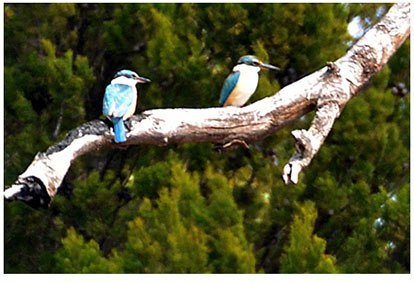
Rockleigh is well situated on the margins of the Mt Lofty Ranges with the drier country of the Murraylands to the east. This has resulted in a large and diverse range of birds from both regions being present in the Rockleigh area, with one hundred and twenty four bird species being recorded on the property. The remnant vegetation preserved at Rockleigh is an important refuge not only for the permanent bird population but also for the many different species passing through the area.This includes several bird species of conservation significance. A walk around the property is always a rewarding experience for birdwatchers and nature lovers alike.
*********************************************************************************************************
KI sonnet – John Smyth
KI Walk
“The sandy track winds on, each corner new,
Enticing me its leafy walls between,
To see what lies ahead, what change of view
Awaits me. Shrubs and trees all shades of green
Cast shadows on the sand to cool my way.
The distant roar of surf ahead I hear,
Still hid, yet full of sounds of foam and spray,
And hinting of the Southern coast so near.
The scent of wattle fills the heavy air.
The call of whipbird shy from thicket rings.
All signs combine that I will soon be there
As nearer to the coast the sand track swings.
At last the promised waves toward me sweep
From ocean vast, so blue and cool and deep”