These are summaries of the main events mentioned
2021 August newsletter
AGM
The AGM on KI is fast approaching and hopefully arrives before any lockdowns. As there is a special resolution to consider at the AGM, I am getting in early on the 21 days notification required.
The special resolution is “to accept the proposed new constitution for Bushland Conservation Pty Ltd”. You will find a proxy form in the email attachments if you wish to vote and are unable to attend. The proxy form needs to be returned to me by 29th September as I will be travelling to KI the next day. To be passed, the resolution must be approved by 75% of those voting.
Dr James Smith, who is managing the cat eradication program, has agreed to be our guest speaker on the day.
Plans for the Sunday are as follows:
In the recent past we have had an open day. However, the KI Wildlife Network has organized their major fund raiser for the year on that day. The focus of their fund-raising is the little penguin. KI Wildlife Network is the group that bought the block of land between our property and the Wilson River
We have no wish to compete with them in any way and some of us may well like to attend their fundraiser. You can get all the details on the following website: https://www.kiwildlifenetwork.com/ki-wildlife-carnival.
If staying around the camp-site, there are always plenty of interesting walks to do.
Grants
Peter Vincent, and others, have been busy applying for Revitalising Private Conservation Land grants. We have applied for funds to build a large enclosure at Rockleigh to house a seed orchard and a grant to fund more cameras for KI to aid in the cat eradication and bandicoot monitoring. Both grants also incorporate an application to fund new signs and on Rockleigh, guards and plant growing.
Meanwhile the work done on Rockleigh is looking good, helped no doubt by good follow-up rains exceeding 60mm. The wattles have been putting on an excellent display and orchids are there to be found.
2021 July Newsletter
The very timely rains have delivered 57mm to Rockleigh. It is just what we need for the big planting weekend.
Camera Donation
This year we are also asking you to consider make a donation to sponsor a camera. Sponsored cameras are an initiative of the cat eradication group and will be used to monitor bandicoot sites as a priority. Such cameras also pick up details of other animals of interest such as echidnas and feral cats. These cameras are expensive as they automatically send data back to the researchers. At a cost of about $1800, a donation of $40 per shareholding would allow us to sponsor one camera, so please would you consider donating $40 or more.
In the words of Peter Vincent-
“I personally see the protection of what appears to be the last remaining bandicoot population on Dudley Peninsula as the top priority. Clearing out the feral cats from Dudley Peninsula, at a cost of hundreds of thousands of dollars, provides the opportunity to re-populate the peninsula from the remaining bandicoots on our property, if they survive. This would be a fantastic outcome and a clear demonstration of the benefits of heritage agreements and of public and private cooperation on conservation efforts.”
As a group, we have done little to assist with this significant effort to eradicate cats. This is one way we can help. (On the other hand, through the foresight of John, Robert (Alf) and others we have preserved the habitat!) If we don’t make the target, the Board will make a decision on whether to top up the amount from our savings or give the donated money to the general cat eradication fund.
For the sake of the book-keeping, please just make a single payment of the annual fee combined with your donation. Anything over the $100 I will assume is for the camera unless you email me otherwise. I am very aware and thankful to those of you who normally pay well above the annual fee.
AGM
Dr James Smith, who is heading up the cat eradication program, has agreed to be guest speaker at our AGM on Saturday 2nd Oct.
2020 October Newsletter
The AGM went well with 26 people attending and 15 shareholdings represented. It was particularly good to see some of the next generation there. We had a few campers on Friday and Saturday but only D. braved the forecast rain and stayed on Sunday night. He estimated about 10 mm of rain fell overnight. Thank you to all the experts among our membership who so freely lead walks and help others learn about the area in general and plants in particular.
Directors
Our current Chair, thanked B. for his years of service on the Board. B. retired to have more time to rehabilitate their Harrogate block burnt out in the fires earlier this year but will continue in his role as Property Coordinator for Rockleigh. He is replaced as a director by D. .
Surrender of Shares
A number of shareholders have expressed an interest in leaving their shares to the Company.
I reported that our best advice to those wishing to do so is to either have a clause in the will stating your wish is to surrender your shares to the Company in which case the shares are cancelled, or to instruct the executor to sell the shares and give the proceeds to the Company. The former gives the Company an extra shareholding which could be used to raise money to purchase new land or perhaps split a large shareholding that is for sale. The latter gives the Company cash to be used as required or as stipulated in the will.
Rare orchid – thanks to D. for the following:
Hello members,
Early in September I helped ecologist Jerry Smith search for Caladenia gladiolata “Bayonet Spider-orchid”. This orchid is critically endangered in the Southern Lofty region with just a few plants hanging on in Scott Creek Conservation Park.
Historical records show it did occur in the Tothill Ranges. There are a few records from the late 1970s to early 80s. Another known location was from Hornsdale in the early 1900s, now well cleared.
Having seen the habitat at Alligator Gorge where a few hundred plants still survive it still seems a possibility it might be in the Tothills. It prefers hillside woodlands with grassy/herb understorey where it can get some sunshine during the day to warm it to release its strong scent. Flowering time is from August to early October.
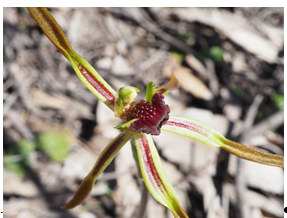

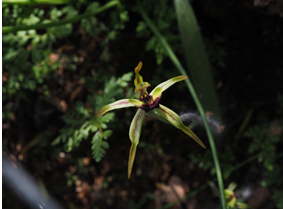
The first 2 images are from Alligator Gorge. Note thick calli. The smaller form is from Scott Creek CP.
To anyone interested in helping find this orchid, please take a photo of any orchid which looks to be this species anywhere in the Northern Lofty region and record the location. This would be a great break through if this species could be rediscovered in this region.
Thanks for keeping an eye out for special plants. Regards D.
Property Reports – Highlights
A. had cameras, recently purchased with grant money, on display, as well as some of the photographic results. These will be used for monitoring a variety of things eg roo numbers, occupants of burrows and users of tracks. It was also suggested they could be used to determine the pollinators of various plants, especially orchids. A. pointed out the need to explore data storage for all the data produced by the cameras. This could be valuable information for researchers in the future.
P. outlined his ideas for a more rapid revegetation of Rockleigh using Heritage Agreement Grants. With his valuable help the management group has applied for a $10,000 grant this year and, if successful, we will apply for the larger grants available next year. A key point in the application is to plant with the aim of helping tide the Diamond Firetails over winter as recommended in Grace Hodder’s research on the bird. Another element to the grant is using outside expert help and, to this end, P. has been in discussion with the Goolwa to Wellington Local Action Planning Association (GWLAP). This group has a good reputation in revegetating in many types of environments.
All the best G. (Editors note: members family names deliberately removed.)
2020 September Newsletter
Hello everyone,
AGM
The AGM this year is to be held at Webb Gap in the Tothills on Saturday 3rd October at 1:30pm. Three directors retire by rotation. They are our current Chair, A B, Bn L and myself. As reported at last year’s AGM, I will accept another term, but we are looking for a replacement secretary by the end of 2021.
The Board has discussed a draft of our new Constitution with Fraser Bell, the lawyer advising us. We believe that we are almost “there”. In the next few months we will send the possible final draft to those who volunteered to help with rewriting. An item for discussion at the AGM will be whether we call a special meeting next year after the “final” draft has been distributed to all shareholders so that a vote on its acceptance can be held.
I have attached the Profit and Loss and the Balance Sheet. The main point of difference between this year’s report and previous years’ is the positioning of the Commonwealth money we received to buy Rockleigh. Rather than being a loan and listed as a liability it now appears under shareholders equity. This is a result of it being confirmed that the initial grant now has no strings to it.
Grants
Both J.S and A.W. have been reimbursed for mileage traveled in the work they do in the Tothills, with more available for next year’s expenses. A.W. has already purchased some motion sensitive cameras and is familiarising himself with their operation.
P.V. has invigorated the Rockleigh management group and is assisting us in applying for the newly available Heritage Agreement grants. The aim will be to revegetate some of the Rockleigh land specifically to help the Diamond Firetails survive each year. We will be using Grace Hodder’s research and recommendations to help in the application. (Grace has recently finished her PhD studies on the Diamond Firetail in the Mt Lofty Ranges and our property was one of her sites)
2020 August newsletter
A very successful working bee was conducted in beautiful weather over the weekend. My sincere thanks to John, David, Andrew, Barbara, Michelle, Janet, Marg, Tom B, Peter, and Neil for all their hard work and good company. We managed to construct and install 100 large mesh guards. This involved weeding around the plants first, perhaps removing old guards and in the case of the smaller old mesh guards, installing them on other needy plants.
David and I also managed to spray the false caper along the roadside and where it had impinged on our land adjacent to the road. A couple of bridal creeper plants and the odd boxthorn were also removed.
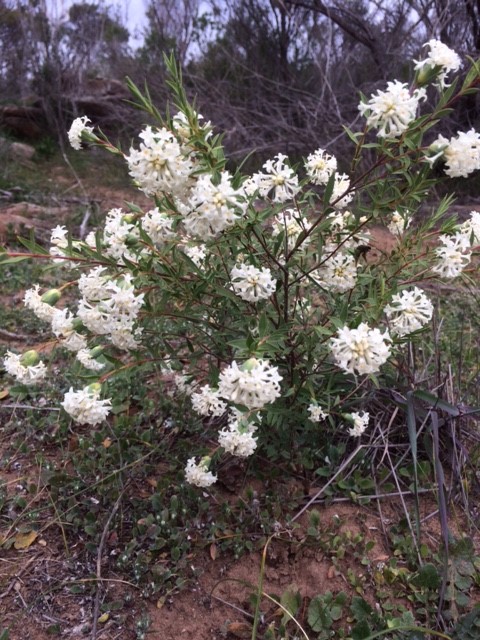
Amid all the hard work there were many flowering shrubs to admire, with the Senecios covering broad areas of the land. A bird list of some 60 species was also compiled. Most interesting among the birds was the presence of 4 different cuckoo species and a spotted nightjar. Peter was also witness to the mating flight of a pair of Australian Hobbies (Little Falcons).

Friends of Private Bushland
A couple of weeks ago 20 members of this group arrived at Rockleigh for a morning tour and lunch. Bren Lay led a very informative and interesting walk around the property. It was a very pleasant way to meet the dedicated members of this group. One thing I learned, though unfortunately a bit late, is that kangaroos will latch onto the base of a plant and rake their teeth up the stem. If they don’t uproot it they effectively ring bark it. And so, the demise of what had been some lovely young callitris from which the corflute guards had recently been removed, was explained.
All the best Graham
2020 July Newsletter
Hello everyone,
Working Bee
The working group for Rockleigh have set aside the first week-end in August (1st and 2nd) for a working bee. There are a number of tasks to be done:
- Many plants need weeding
- Many corflute guards need to be replaced with larger mesh guards
- False caper and box thorns need to be sprayed
Grant
Largely due to some excellent record keeping by A. W., we have won a $5,000 grant to fund Andrew’s and John’s travel for soursob and fox control as well as to purchase 3 motion sensitive cameras.
2020 Newsletter July 1
The recent news from KI about bandicoots and dunnarts is interesting and heartening as is the sale of lot 4, adjacent to our property, to KI Wildlife Network. The cat eradication on Dudley Peninsula is underway and it will be great to get some information on how it is going.
Reports from the western end of the island indicate pockets of unburnt vegetation harbouring a variety of birds and mammals. The problem is insufficient food to see them through to the recovery of the burnt area. Some translocation of species (eg emu wrens) is being done (and cats removed!)
Rockleigh has received a reasonable amount of rain and some of the eucalypts are flowering brilliantly.
Several things have happened at Rockleigh over the last few months. B. l. has engaged a well qualified “deer stalker” to sort out our deer problem. He walks around on a moon lit night but has so far seen none although he has reported many kangaroos. Nic and Angela have solved the silting up of the pipes under the ford. They have also planted out a variety of seedlings raised from seed collected on the property. If you are visiting Rockleigh you will notice that the wood pile at the campsite is very neat, also thanks to Nic. Angela, Nic, P. V., M. B. and I have also weeded a number of the seedlings planted out over the last few years.
There is much more weeding to be done. More substantial guards are required for many of the trees and shrubs. False caper is once again appearing on the roadside and on our southern edge. There are a few box thorn bushes that need to be removed.
In the Tothills, JS and A.W have just completed the spraying of sour sobs and A.W. is now able to relieve J.S. of that annual task in the future. Our thanks to you both.
2020 February Newsletter
Greetings All,
After a successful watering day a few weeks ago at Rockleigh we have been fortunate to have received at least sufficient rain to dampen the soil and put some water in the creeks. Dodoneas that were hanging their leaves in thirsty depression a few weeks ago are standing tall and green. There is a tinge of green and your feet no longer “crunch” at every footstep.
The crimson chats and woodswallows seem to have departed but the rainbow bee-eaters are still around. A pair of white fronted chats, pipits, whiteface, 3 hooded robins and a group of yellow-rumped thornbills made up the ground feeding contingent on the far side of the creek.
For those of you who helped on the watering day you may recall that the guards on the trees hillside of the old camping ground were missing. Once again they were all gone, possibly due to the wind but in some cases certainly helped by the roos. Marg Brown and I watered them again, replaced the guards and placed dead branches around them to deter the roos. This method is used in Turkey where Marg visited a few years ago.
I spoke to the roo shooter for Rockleigh this morning and he reported seeing a koala on his last visit back in November. That is now 2 sightings of a koala on Rockleigh. I know some of you are very much against culling roos and none of us like the idea but see it as a necessity if we are going to maintain a healthy ecosystem. We had a permit to shoot 30 western grays and in their 2 visits the shooters managed to get half that number. From what we saw yesterday the population is still very healthy. However, we are left with the question of what to do about the feral deer on our property as the shooters never saw them.
A bit more veldt grass destruction was carried out around the current campsite which is looking remarkably veldt grass free until closer inspection. Persistence must eventually pay off.
Best wishes, Graham
2020 January Newsletter
The Rockleigh watering day was very successful. There had been very few “deaths” as a result of the recent hot weather although some plants were distressed. With a workforce of 12 people, all the watering, and the removal of guards where necessary, had been accomplished by lunchtime. All in all it was an excellent day with the work accomplished, new people met, old acquaintances renewed and conversations had. Special thanks go to my brother for delivering 2000 litres of water and helping out on the day.
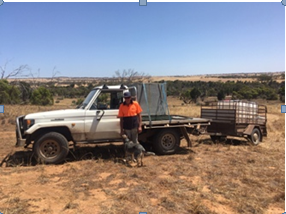

Many thanks to the Vincent siblings, and everyone else, for their untiring help on the day.
A final reminder to anyone wanting to comment on whether or not to change the Bushland Company structure, to please do so by Feb 14th.
2019 July Newsletter
Since the company that became Bushland Conservation Pty Ltd was formed over 40 years ago many things have changed, including the cost of living and the value of land. We have two important documents that guide our Company. The first document is our Charter, a document that sets out our guiding philosophy and principles. The second is a formal Constitution, required by law under the Companies Act.
Our Charter, emphasising our fundamental principle, states “the sole object for which the company is established is to purchase and/or lease land in its natural state in order to secure the same from agricultural exploitation and to protect and preserve existing landscape, flora and fauna.” This is our fundamental guiding principle. We are not a regular company trading for profit.
At present Item 5 of our Charter states that we aim: “To seek no gain from the investment in the company other than maintaining the value of shareholder investment through linking the share price to the Consumer Price Index.” This CPI link was adopted by members at foundation and reaffirmed in 1991 and it is currently used to determine the value of our shares when they are sold and purchased.
We can no longer assume that CPI gives “fair value”. Legal advice we have received (advice that is in accordance with our Constitution) states that the price of a share should be fixed by the member selling the share, and should represent the “fair value” of the share. We have also been advised that the Company (Bushland Conservation Pty Ltd) must not itself value the shares.
So how should a seller value their shares? Apart from our dedicated and generous shareholders our only asset is the land. There is no official schema for valuing land held for environmental heritage. As we cannot use it to produce an income it could be said to have little dollar value. Or it could be argued that our land is of exceptionally high value because it is rare and because natural habitat is ever diminishing.
A guide to fair value could be gained from recent similar sales of heritage land. In this case the value depends on the condition of the trees and scrub, the amount of restorative and maintenance work required and the convenience of the land for visiting and camping etc. There are some of our members who have knowledge of recent such sales but these are not common and not definitive. In reality, as in any other market transaction, shares are only worth what a buyer is willing to pay. So a member who is selling shares needs to set what they think is a fair asking price and negotiate with the buyer from there.
The Directors therefore strongly believe that it is essential to rescind the CPI link. At the 2019 AGM on October 12th we will, as an interim measure, propose that our Company NOT adjust the share price according to the CPI for the last financial year (+1.3%). We will set aside time for members to present their views concerning the general issue of the CPI link and the concept of the fair value of our shares. Our present intention is to convene a special General Meeting of our Company at a time and place to be decided at the AGM. At this special meeting the Directors will propose that the link between the CPI and our share price be abolished.
We ask that you think about these issues with some urgency. We hope that members will contact our Secretary (Graham White- email gandkwhite@iprimus.com.au or mobile 0404 038 852 or land-line 8370 7951) to share your thoughts.
2018 October AGM newsletter
The weather was fine, the campsite a delight, the company excellent and the AGM went well too. 17 shareholders attended and it was quite inspirational to have Doreen Matheson there. Julia, Daniel and Brodie from our youngest generation took the initiative to supply us with afternoon tea during the meeting. Well done and thank you. We had 2 visitors camp with us and 6 guests on the day.
The Chair, Bill Blessing, welcomed all present and spoke briefly on the recent death of Jeanine Vincent who has been a strong supporter of our Company and a dedicated environmentalist for many years.
Our first guest, Karleah Berris, attending with her family, spoke of the planned cat eradication program for Dudley Peninsula. She demonstrated how the “Felixer 3” trap worked – basically it uses video recognition software and 4 sensors to determine if an animal is a cat. If it is, it is hit by a globule of 1080 poison which it will then ingest by grooming itself and consequently die. At this stage no poison is being used and the software is being tested and upgraded to improve its recognition rate as it currently would only target 50% of cats which approach it.
Our second guest was Pat Hodgens who spoke about “Land for Wildlife” and their work in trying to establish the number and distribution of the KI Dunnart and the Southern Brown Bandicoot on KI. He is very passionate about protecting these animals and keen to set camera traps on our property to determine whether they are present though it is not expected. Permission to do this was granted.
Bill Blessing and David Smyth were elected as Directors and retiring Director, Janet Pedler, was thanked for her valuable input over the many years she has served on the Board.
The property reports highlighted the lack of rain on the mainland, the excellent turnout for Bill Matheson’s memorial planting day at Rockleigh and that TERN (Terrestrial Ecosystems Research Network) had revisited the Tothills and had permission to set up sites on our KI property. One of our KI shareholders, Dr Richard Glatz, will meet with them when they visit. One worrying aspect for the management of our KI property which was mentioned by John in his recent newsletter is the tracks being forged by trail bike riders.
Graham
2017 Rockleigh Newsletter working bee.
Weather wise it was a miserable weekend with very strong winds and quite a bit of rain. Cosequently, campers were at a minimum but much was achieved.
On the Saturday we had 11 people present, Bren and Elizabeth, John and Reiko, John S, David, Tom R., Tom B., Barbara, Margaret and me.
The overgrown track leading to the old campsite was cleared and the track itself repaired. (The problem with the track is water running down and eroding it. Banks have been formed to direct the water away from the track.) Lots of false caper was pulled up from the roadside and in our property nearby and the northern fence line was repaired and kangaroo “runs” blocked where they gave access to sheep. Some 40 odd plants were put in the ground, some guards removed and others replaced. Several of the young Casuarinas had been damaged by kangaroos as they grew above the smaller guards. Larger guards, those made by Ross several years ago, were put over these. Lots of veldt grass plants were removed at and near the campsite. This is an area where the veldt grass is not so prolific and provides an opportunity to manually remove it. Marg’s wish is that everyone who goes to Rockleigh makes a point of removing at least 6 plants in this area each visit. The campsite area is looking really good with native grasses now predominant.
Andrew had 14 Accacia argyrophylla plants which we put in on the sandy rise at the back of the old camp site. We spent the rest of the morning removing the remaining false caper plants from the roadside.
Many thanks to all who helped out. Despite not being able to do the spraying of the Veldt grass as planned because of the inclement conditions, I think everyone was pleased with just how much was accomplished.
Graham

Figure 1: E. fasciculosa (pink gum)
Those of us who helped at the working bee at Rockleigh on the wintry weekend of July 29-30 were well rewarded by seeing the results of all the hard work that had gone before. In particular, the sustained revegetation of the previously cleared cropping land along the road is now a delight. The range of species planted over many years, their recovery from the bushfire, and the appearance of spontaneous seedlings show how worthwhile it has been. Two standouts were eucalypts in full bloom, the pink-flowered blue gum (Eucalyptus leucoxylon ssp.leucoxylon), and the white-flowered pink gum (E. fasciculata). The blue gum drops a carpet of pink blossoms from mature trees along the roadside just to the east of our block, and it is great that it is natural in the area. Such coloured forms are sold in nurseries as E. leucoxylon ‘Rosea’. The pink gum is close to the northern limit of its range at Rockleigh. It is “almost” a South Australian endemic, with a few stands in the Little Desert of western Victoria, just over the border from the South East population. Its name E. fasciculata comes from the bundles (“fascicles”) of terminal flowers so prominent when it is in flower (see photo). The lack on anthers on the outer long stamens is also characteristic of this species.
David

Figure 2 : Pittosporium ‘invading’ the veldt grass
2016 March Newletter
Greetings All,
New shareholder
We welcome S. H to the Company. S is an artist who lives on KI. He is very keen on the bush and conservation and will be a great help to D. S. and others in the management of the KI property. Many of us were fortunate to meet S., and sample his scones, at the open day on KI after the last AGM. S. recently purchased G. R.’s shares. We thank G. for his support of the Company over the last 22 years.
Awards
Congratulations to Janet Pedler and Lynn Pedler. Janet received a much deserved Pride of Australia Medal in the Environment category. Janet’s work in conservation and the environment has been ongoing for almost 40 years both privately and in conjunction with many environmental organisations. One particular contribution that stands out to me because I have attended one of the many courses she has conducted, is her association with the Nature Conservation Society of SA and the consequent development of the Bushland Condition Monitoring Method. Lynn received Birds Australia’s J N Hobbs Medal “…in honour of his extraordinary field skills and tireless efforts to locate and manage some of South Australia’s most elusive and threatened birds” We are probably all familiar with Lynn’s work in protecting Glossy Black Cockatoos on KI.
Graham
2015 newsletter
AGM
After enjoying a weeks good camping on KI for our recent AGM, it was recommended by those present to hold the next one during the school holidays and if possible at the time of a full moon. This makes it the weekend of October 15th and 16th with the AGM on Saturday 15th. By rotation the 2016 AGM will be at Rockleigh. This is somewhat later than usual and could put us in a spell of hot weather. Let me know if you think we have got it wrong!
Property Coordinators
Each of our properties has a Property Coordinator:-
Tothills: John Smyth,
KI: Deb Sleeman
Rockleigh: Bren Lay
The following people have agreed to work with those coordinators as able and when required:
Tothills; Andrew Wurst, Tom & Alison Bullock & Steve White
KI: James Doube, John Matheson & Reiko Hosokawa
Rockleigh: Graham White, Elizabeth Lay, Tom Reeves & Marg Brown
Each group becomes a Local Management Committee to work closely with the Board of Directors in helping to make decisions and see that work is done. There are many other shareholders who are happy to help out on special projects, eg tree planting. If you would like to be a part of any of these groups please let me or any other Director know and I will add your name. It is hoped that whenever some work needs to be done that I can get an email out to all shareholders inviting you to help. That brings me to the next topic.
New Members:
We welcome J. S. as the newest member of our group . We hope she and husband J. L. enjoy their association with us.